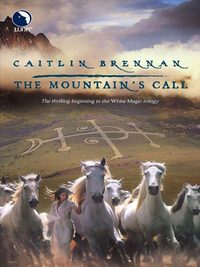
Читать книгу: «The Mountain's Call»
Selected praise for Caitlin Brennan’s
White Magic series
The Mountain’s Call
Song of Unmaking
Shattered Dance
“Definitely a don’t-put-this-down page-turner!”
—New York Times bestselling author Mercedes Lackey on The Mountain’s Call
“Animal lovers and romantic fantasy aficionados alike will appreciate this…coming-of-age story and an exhilarating romantic adventure.”
—Romantic Times BOOKclub
“A riveting plot, complex characters, beautiful descriptions, and heaps of magic.”
—Romance Reviews Today on The Mountain’s Call
“Caitlin Brennan has created a masterpiece of legend and lore with her first novel. Hauntingly beautiful and extremely powerful…Take Tolkien and Lackey and mix them together and you get this new magic that is Caitlin’s own. You will stay enthralled with each page turned.”
—The Best Reviews on The Mountain’s Call
“This…second book in this magnificent romantic fantasy series…is full of more action, romance and drama than its prequel…. The battle scenes are magnificent, the characters are realistic and the storyline is pure magic; readers will eagerly await the next book in this tantalizing series.”
—The Best Reviews on Song of Unmaking
CAITLIN BRENNAN
THE MOUNTAIN’S CALL

For the Ladies

Contents
Chapter One
Chapter Two
Chapter Three
Chapter Four
Chapter Five
Chapter Six
Chapter Seven
Chapter Eight
Chapter Nine
Chapter Ten
Chapter Eleven
Chapter Twelve
Chapter Thirteen
Chapter Fourteen
Chapter Fifteen
Chapter Sixteen
Chapter Seventeen
Chapter Eighteen
Chapter Nineteen
Chapter Twenty
Chapter Twenty-One
Chapter Twenty-Two
Chapter Twenty-Three
Chapter Twenty-Four
Chapter Twenty-Five
Chapter Twenty-Six
Chapter Twenty-Seven
Chapter Twenty-Eight
Chapter Twenty-Nine
Chapter Thirty
Chapter Thirty-One
Chapter Thirty-Two
Chapter Thirty-Three
Chapter Thirty-Four
Chapter Thirty-Five
Chapter Thirty-Six
Chapter Thirty-Seven
Chapter Thirty-Eight
Chapter Thirty-Nine
Chapter Forty
Chapter Forty-One
Chapter Forty-Two
Chapter Forty-Three
Chapter Forty-Four
Chapter Forty-Five
Chapter Forty-Six
Chapter Forty-Seven
Chapter Forty-Eight
Chapter Forty-Nine
Chapter Fifty
Chapter One
The Mountain floated over the long roll of field and forest. Even in summer its peak was white with snow. In early spring, when the grass had begun to grow green in the valleys, its summit was locked in winter.
There was a fire of magic in its heart, welling up from the deep roots of the earth. It bubbled like a spring from the white fang of the peak, and rippled in waves through the vault of heaven. The tides of time began to swirl and shift.
In the citadel on the Mountain’s knees, the master of the Schools of Peace and War woke from a stranger dream than most. He stumbled from bed, flung open the shutters and peered up at the glow of dawn on the snowbound slopes.
Every spring the power rose; every spring the Mountain’s Call went out, summoning young men to the testing. Every spring and summer they came, straggling in from the far reaches of Aurelia’s empire, coming to claim the magic that they hoped was theirs. White magic, stallion magic. Magic of time and the gods.
This year’s Call was different. How it was different, or what it portended, the master could not tell. The gods in their pastures, cropping the new green grass, would not answer when he asked. The Ladies in the high valleys, greater than gods, chose not to acknowledge him at all.
This was a mystery, that silence said. Even the master of the school must wait and see, and hope that when the answer came, it would be one that he could accept.
Valeria had been walking in a fog for days. Sometimes she wondered if she was ill. Other times, she was sure that she was losing her mind.
There was a voice in her head. It called to her with the sound of wind through pines. It whispered in the hollows of her skull. Come. Come to me.
She staggered on the path to the widow Rufo’s house. Her mother’s hand gripped her wrist and wrenched her upright.
The pain helped Valeria to focus. It was harder every day. Sometimes now she could barely see. She had to struggle to hear what people said to her. She thought she might be losing her mind altogether, except that there was a deep sense of rightness to it. She was meant to hear this call. She was meant to go—
“Valeria!” Her mother’s voice cut through the fog of confusion. She blinked half-wittedly. She was standing in the widow Rufo’s cottage. Her head just missed brushing the roofbeam.
“Valeria,” Morag said. “Start brewing the tea.”
Valeria’s hands knew what to do even when her wits were drifting away toward gods knew where. She dipped water from the barrel by the door and poured it into the kettle, then set it to boil on the hearth. The fire had burned too low. She whispered a Word. The banked logs burst into flame.
The widow Rufo’s breath rattled. Morag spread a paste of pungent herbs over the bony chest and covered it with soft cloths. Herbs just as pungent steeped in the boiling water, brewing into tea. When it was strong enough, Morag coaxed it into her sip by sip.
Valeria squatted by the fire. It was full of visions. White mountains. White clouds. The toss of a white mane, and a noble head on a proud arched neck, turning to fix her with an eye as dark as deep water. The depths of it were full of stars. Come, said the white god. Come to me.
“She’s getting worse.”
Valeria lay in the wide bed with her three younger sisters. She was the innermost, with Caia’s warmth on one side and the chill of the wall on the other. Her sisters were snoring on three different notes. They almost drowned out the murmur of their mother’s voice on the other side of the wall.
“She can barely keep her mind on her work,” Morag went on. “She started to say a birthing spell over Edwy’s burned hand this morning—thanks to Sun and Moon I caught her in time, or he’d have sprouted a crop of new fingers.”
Her father’s laughter rumbled through the wall. Morag slapped him. He grunted. “There now,” he said in his deep voice, roughened from years of bellowing orders on battlefields. “What was that for?”
“You know perfectly well what for,” Morag said sharply. “Our daughter is losing her mind.”
“If she were a boy,” Titus said, “I’d be thinking it was the Call. I saw it a time or two when I was in the legion. One of the youngest recruits would get up one fine spring morning with his eyes all strange, pick up his kit and walk out of the barracks, and no one with any sense would try to stop him. Our girl’s just about the same age as they were, and gods know she has a way with animals. Horses follow her like puppies. The way she taught the goat to dance—”
“She is not a boy,” said Morag. “This is a spring sickness. There’s magic in it, she stinks of it, but it is not—”
“What if it is?”
“It can’t be,” Morag said flatly. “Women aren’t Called. She has a good deal more magic than she knows what to do with, and it’s laid her open to some contagion off the mountains.”
Titus grunted the way he did when he was not minded to argue with his wife, but neither was he inclined to agree with her. “You’d better cure her, then, if she’s as sick as that.”
“I’ll cure her,” said Morag. Her tone was grim. “You go in the morning, husband, and talk to Aengus. She likes that son of his well enough. There’s time to make it a double wedding.”
“I’m not sure—” said Titus.
“Do it,” Morag said with a snap like a door shutting.
That was all they said that night. Valeria lay very still, trying not to touch either Caia or the wall. Caia would not be pleased at all, not after she had bragged to everyone about being the first of all four sisters to marry. She was a year younger than Valeria and the beauty of the family. Their father had not had to go begging for a husband for that one. Wellin Smith had asked for her.
Aengus’ son Donn was unlikely to refuse Titus’ eldest daughter. He had been trailing after Valeria since they were both in short tunics. He had an attractive face and decent conversation, and a little magic, which was useful in his father’s mill. He could offer his wife a good inheritance and a comfortable living, even a maid if she wanted one.
It was a good match. Valeria should be happy. Her mother would cure her of these dreams and fancies. She would marry a man she rather liked, give him children and continue with her education in herb-healing and earth magic. When the time came, she would inherit her mother’s place in the village, and be a wisewoman.
That was the life she was born to. It was better than most young women could hope for.
She was ill, that was all, as her mother had said. Because it was spring and she was coming to her sixteenth summer, and because she had listened hungrily all her life to stories of the Call and the white gods and the school on the Mountain, she had deluded herself into thinking that this bout of brain fever was something more. That was why she was dreaming in broad daylight and stumbling over her own feet, and feeling ever more strongly that she should take whatever she could carry and run away. She could not possibly be hearing the Call that had never come to a woman in all the years that it had been ringing through the planes of the aether.
Valeria slid from doubt and darkness into a dream of white horses galloping in a field under the white teeth of mountains. They were all mares with heavy bellies, and foals running beside them. The young ones were dark, black or brown, with the white of adulthood shining through.
They ran in wide sweeps across the green field. The swoops and curves made her think of a flock of birds in flight. Augurs could read omens in the passage of birds, but these white horses could shape the future. They could make it happen. They were the moon, and time was the tide.
A voice was speaking. She could not see who spoke, or tell if it was a man’s voice or a woman’s. It came up out of the earth and down from the air. “Look,” it said. “See. Understand. There is a prophecy—remember it. One will come of the pure line, true child of First Stallion and Queen Mare. That one will seal the bond of soul and spirit with a child of man. Together they shall be both the salvation and destruction of the people.”
Words welled up, a flood of questions, but there was no one to ask. She could only watch in silence.
The mares and foals circled the field in a graceful arc and leaped into the sky, spinning away like a swirl of snow. Down on the field, a single pale shape stood motionless. The solid quarters and the heavy crest marked him a stallion, even before he turned and she recognized him. She had dreamed him once already.
He was young, dappled with silver like the moon. As massive as he was, he was somewhat soft around the edges. He was beautiful and perfect but still, somehow, unfinished. Come, he said as he had before. Come to me.
She woke in the dark before dawn, with the dream slipping away before she could grasp it. She was standing in the open air. The sky was heavy with rain, but it had not yet begun to fall. She was dressed in her brothers’ hand-me-downs. They were faded and much mended, but they were warm. There was a weight on her back.
She remembered as if it had been part of her dream how she had slipped out of bed without disturbing her sisters. She had found the old legionary pack that her eldest brother Rodry had brought home on his last leave, and filled it with food and clothing, enough for a week and more. When she woke, she was filling a water bottle in the stream that ran underneath the dairy house.
Her face was turned toward the Mountain. It was too far away to see, but she could feel it. When she turned in the wrong direction, her skin itched and quivered.
The bottle was full. She thrust the stopper in and hung it from her belt. The sky was lightening just a little. She set off down the path from her father’s farm to the northward road.
Her mother was waiting where the path joined the road. Valeria’s feet would have carried her on past, but Morag stood in the way. When Valeria sidestepped, Morag was there. “No,” said her mother. “You will not.”
“I have to,” Valeria said.
“You will not,” said Morag. She gripped Valeria’s wrists and spoke a Word.
The cords of the binding spell were invisible, but they were strong. Valeria could not move her numbed lips to speak the counterspell. Spellbound and helpless, she staggered behind her mother. Every step she took away from the Mountain was a nightmare of discomfort, but she could do nothing about it. Her mother’s magic was too strong.
The root cellar smelled of earth and damp and the strings of garlic that hung from the beams. Barrels of turnips and beets and potatoes lined the walls. There was one window high up, barely big enough for a cat to climb through. The trapdoor in the ceiling was securely bolted on the other side.
It was not terribly uncomfortable, for a prison. Valeria had a feather bed to lie on. She had a firepot and a rack of lamps with more than enough oil to keep them burning. Morag had left her with the herbal and the book of earth spells, but a binding kept her from working any spell that might help her escape.
“I’ll let you out on your wedding day,” Morag had said when she shut Valeria in the cellar. “Between now and then, you will do your lessons and ponder your future, and I will see that you get over this sickness.”
“It’s not a sickness,” Valeria said through clenched teeth. “You know what it is.”
“I know what you think it is. You know it’s impossible. You are the only one of my daughters who was born with magic. You will have ample opportunity to develop and use it—but you will do it here in Imbria where you belong.”
“I don’t belong here,” Valeria said. “I belong on the Mountain.”
“You do not,” said Morag. “No woman does. And so they will tell you if you keep on trying to answer their Call. They’ll break your heart. They’ll laugh in your face and send you away. I’m sparing you that, daughter. Someday, Sun and Moon willing, you’ll learn to forgive me.”
That would never happen. Valeria had come out of her dream-ridden fog into a trammeled fury. She was awake now, and her mind was as clear as it could be.
She remembered when she had first heard the story, as vivid as if it had happened this morning. She could see the market in the bright sunlight, with its booths of vegetables and fruit, heaped greens and sides of mutton and beef and strings of fish.
A stranger lounged on the bench outside Lemmer’s wineshop. “Oh, aye,” he said in an odd rolling accent. “The horse magicians send out a Call every spring, just before the passes open in the mountains. It’s meant for boys who are almost men, or men who are still mostly boys. Fourteen, fifteen, sixteen summers old. Never younger. Only rarely older. It binds them and compels them to go to the Mountain.”
Valeria was much younger then, not yet in skirts. Strangers took her for a boy, as lanky and gawky as she was. “Only boys?” she asked this stranger. “No girls?”
“Never a girl or a woman,” the traveler said. “Horse magic’s not for the Moon’s children. It belongs to the Sun.”
Valeria might have liked to argue the point, but she had another question to ask first. “What is horse magic? What does it do? Anybody can ride a horse—even a girl.”
“Anyone can sit on a horse,” the traveler said. “To master the white stallions, the firstborn children of time and the gods—that’s not for any plowboy to try.”
“Sometimes a plowboy does,” said one of the traveler’s companions. He had an even odder accent, and was very odd to look at. He was a head taller than the tallest man that Valeria had seen before, and his cheeks were thickly patterned with whorls in blue and green and red. “Sometimes even a bond-slave can try it. If he hears the Call, if he goes to the Mountain, he can be tested just as if he were a prince. He can pass the testing and be made a rider, and no one ever calls him a slave again. The stallions don’t care if a man was born low or high. They only care for the magic that’s in him.”
“But what do they do?” Valeria persisted. “What is the horse magic? Is it like charming snakes and birds, or teaching goats to dance?”
The tattooed man grinned. His teeth were filed to points. He looked alarming, but Valeria was not afraid of him. “Something like that,” he said, “and something like herding cats, and a little bit like casting the bones. Mostly it’s hard work. Can you ride a horse, child?”
If it had been anyone else, Valeria would have been outraged to be called a child, but this man was so large and so odd and so full of answers to her questions that she could not bring herself to resent it. “I can sit on anything that will let me,” she said. “I’m sure they wouldn’t call it riding, up there on the Mountain.”
The stranger laughed, a joyful shout. “Oh, they would not! But they would approve of your honesty. Maybe you’ll hear the Call, child, when you’re old enough.”
“Maybe I will,” Valeria said. Never mind that she was a girl. Magic came where it would, she already knew that. Who knew what she could be if she put her mind to it?
She would have asked many more questions, but her brothers caught her hanging about where she should not, and dragged her off home. When she could slip back again, the strangers were long gone. Others came in the years that followed and told more stories, some of which answered her spate of questions, but none stayed in her memory as those first two strangers had.
She had dreamed of white horses even before the strangers came to the market. She dreamed that they danced, and she danced with them. Sometimes they danced on the earth and sometimes in the sky. She could see the patterns that they made, how they wove together earth and water and air, and made it all one single shining thing.
She tried to ride the pony as she rode in her dreams. He did not see the point in it, and bucked her off more often than not. The big slow plow horses were more accommodating, but they were earthbound. They had no element of fire. The goats, who loved to dance, were too small for even a child to sit on.
None of them was as perfect as the white dream-horses. None of them would make her a rider. Only the white gods could do that, and only their riders could teach her.
Now, against all hope, she was Called. She was summoned to the testing. The magic was in her, even though she was a woman.
Morag’s binding rattled Valeria’s skull. Her lesser magics were all suppressed. Even the greater one, the one Morag would not acknowledge, was weakened and slow. She had to wait until night, when the sun’s singing was stilled, and humans were asleep in the quiet harmony of the stars. Then if she listened, she could hear the overlapping voices of the world. She resisted the urge to find the patterns in them, and once she had found them, to make sense of them. There was no time for that, only for the Call.
The horses were locked in the stable. The dogs were loose in the yard as they were every night. They were not as intelligent as the horses, but they were more subservient, and for her purposes more useful. They thought it a great game to tug and pull at the bolt that secured the trapdoor, until after a white-knuckled while it slid free.
She was up among them in no time at all. They fell over one another in delight, tongues flapping, tails wagging frantically. She rubbed each big shaggy head and pulled each pair of ears and thanked them from the bottom of her heart. Then she sent them back to guard duty.
Her brother’s pack was back on its hook in the toolshed. The waterskin was beside it. This time Valeria made sure she was not followed. The rats in the walls and the pigeons in the rafters assured her that her mother was asleep beside her father. Morag had committed a cardinal error of warfare, as Titus would be sure to remind her when they woke and found their daughter gone. She had underestimated the enemy.
Anger was still strong in Valeria. It ate the twinge of guilt and the impulse to stop and say goodbye to her brothers and sisters. What if she never saw them again?
What a soldier did not know, he could not betray. That was another of Titus’ maxims. Valeria left them all sleeping the sleep of the happily ignorant.
No one was waiting for her this time. The road was empty under the chilly starlight. She paused where the path turned onto the road. The warding rune on the post there was meant to keep intruders out but not—she drew a breath of relief—to keep the family in. She did not look back. In her mind’s eye she saw her father’s farmstead in its fold of the hills, with its thatched roofs and its wooden palisade and its border of trees.
She said farewell in her heart, but her eyes were fixed on the shadow on shadow that was the wall of mountains. Her feet were itching to begin the journey. The first step was the hardest, but each one after that was easier, until she was striding headlong, almost running, into the north.
Chapter Two
The horse followed Valeria for a day before she gave in to his importuning and let him carry her. He was clean and well fed and his hooves had been trimmed recently, but he refused to acknowledge that he belonged to anyone. He insisted that he had come for her. He was neither white nor a stallion, but Valeria did not care about that. His back was comfortable and his gaits were smooth. She could have paid gold and done worse.
She had defied her mother and abandoned her family, all of whom, in spite of her anger, she missed terribly. She was a fugitive, living off what she could forage and trying to stretch her few provisions for as long as she could. She barely knew where she was going or how long it would take to get there. And yet she was happy, even when the last snow of winter caught her on the road and forced her into an empty barn for a day and a night.
The bindings on her magic had slipped loose after she’d passed the runepost at the border of the farm. She could call fire to warm her and the horse. There was hay in the deserted barn, cut last year but still dry and clean. The horse ate a good deal of it, and she slept on the rest. A few half-wild hens roosted in a corner of the barn. Their eggs were small, but there were a decent number of them. With the last of the bread and dried apples from home, Valeria had a feast while the storm howled outside.
When she rode out through melting snow, the second morning after she came to the barn, she had cut her long hair short. It was practical, and she thought it might also be safer if she was out riding the roads alone, to be taken for a boy. Her head felt odd and light, and her ears were cold.
The horse pranced, glad to be free again. Valeria’s rump was not so happy. It was just beginning to recover from the effects of too much riding after too little practice.
She would need better discipline than that if she was to be a rider. She gritted her teeth and suffered through it.
Before the storm came, she had met few people on the road. Most of those were farmers going to market. She had seen an imperial courier once, galloping flat out on his spotted horse.
A troop of legionaries tramped past not long after she left the barn. She resisted the urge to hide from them. She was not a fugitive. She was Called. Her horse, bridleless and saddleless and obeying her without question, would tell anyone that. So would the road she was on, which led north to the Mountain and the white gods.
In the stories she had heard, the Called could ask for food and lodging at the imperial way stations. The day after the last of her provisions ran out, she tested it. It was that or resort to stealing.
The man in charge of the station had the same toughened-leather look as her father, and the same accent, too. Wherever a legionary came from, after twenty years in the emperor’s service he came out talking that way, usually with a voice gone raw from bellowing orders in all weathers above all manner of uproar.
He did not ask her who she was or what she was doing. As she had hoped, it was obvious. He gave her a seat at the table in the mess hall and a bed in the barracks, and showed her where she could stable the horse. When the horse was bedded down with a manger full of good hay and a pan of barley, she went to claim her own dinner.
There were only a handful of other people in the station tonight. They were all imperial couriers either resting between runs or waiting for the relay to reach them. Most of them, like the stationmaster, asked no questions. One or two watched her without being blatant about it. They all seemed to know each other. She was the only stranger.
She finished her dinner as quickly as she could, trying not to choke. She barely tasted the stew and bread and beer. She escaped before anyone could strike up a conversation.
She left before the sun came up. The cook was just taking the first loaves out of the oven when she came down from the room. He gave her a loaf so hot and fresh she could barely hold it, with a wedge of cheese thrust into a slit in the crust. The cheese had melted into the bread. She ate it in a state of bliss, and belched her appreciation.
“Gods give you good luck,” the cook said, “and a safe journey. May the testing favor you.”
She hoped she did not look too startled. “Thank—thank you,” she said.
The cook smiled and touched her forehead. “For luck,” he said. “Never had anyone Called from your village before, did you?”
She shook her head. “I’ve heard all the stories. But—”
“You give luck,” the cook said, “and take it, too. Stop at the stations. Don’t try to go it on your own. Most people respect the Call, but a few might try to steal the luck.”
“How do they—”
The cook slashed his hand across his throat. “It’s in the blood, they say. I don’t believe it—I think it’s in the soul, and killing you unmakes it. Those on the Mountain, they know for sure, but they’re not telling the likes of us.”
“I don’t know anything about it,” Valeria said.
“You’ll learn,” said the cook. “Best be on your way now. It’s a long way to the Mountain, and time’s not standing still.”
“How long—”
“Three days for a courier,” the cook said. “Ten, maybe, at ordinary pace, and allowing for weather and delays. Ask at the stations if there’s a caravan heading the way you need to go. That’s safest. You might even meet others of the Called.”
A shiver ran down her spine. In her dreams she had always been alone. She had not thought about what the Call would mean. She went to a place where everyone had the same kind of magic as she did. She would not be alone any longer.
If and when they found out she was not a boy—
She would deal with that when it happened. For now she had to go to the Mountain. That was all she could think about, and all she needed to think about.
When she fetched the horse from the stable, having discovered that she could commandeer a saddle and bridle for him, she was struck with a sudden attack of cowardice. She turned him southward, back the way she had come.
The Call snapped like a noose around her neck. She almost lost her breakfast. She turned northward and saved it, but the message was clear. She was bound to this road. She had to ride it to the end.
The hunt passed her not long after the sun came up. The hounds came first, then the huntsmen. The hunt itself was a little distance behind. She had seen few nobles in her life, but these were obviously wellborn. Their horses’ caparisons were elaborate, with ornately tooled saddles and chased silver bits and stirrups. The long manes were braided with ribbons in colors that matched the riders’ coats. The riders wore enough gold to dazzle her.
They looked down their noses at the lone traveler on the side of the road. She felt grubby and common in her patched coat. Her boots were walking boots—one of the lordlings remarked on them as he rode elegantly by. The horse was still in winter coat. Even a good grooming could not make him look less shaggy.
Valeria lifted her chin and looked the riders in the eye. She was Called. And what were they?
As soon as she did it, she knew she had made a mistake. One of them, big and uncommonly fair-haired for this part of the world, raked her with a glance that sharpened suddenly. She had seen that look in the leader of a dog pack that had been going casually about its business until it caught wind of a newborn lamb. This was the same sudden gleam in the eye, the same flash of fang.
He was not hunting to eat. He was hunting for pleasure. It mattered little to him whether his prey was animal or human.
Valeria kept the horse, and herself, perfectly still. It might be too little too late, but she called up what magic she could in her rattled state, and did her best to seem as dull and unworthy as possible. Above all, she took care not to give him any further indication that she was one of the Called. If anyone would kill her for luck, this man would.
It seemed to work. The nobleman let his eyes slide away from her. The rest of them rode past without stopping or pausing, with only brief glances if they troubled with her at all.
Valeria nearly collapsed in relief. She was safe, she thought. Even so, she stayed where she was for long enough to see how, just before the road bent around a hill, they turned off into the trees. Then she waited a while longer, until she was sure she no longer heard them.
When she rode on, she stayed well away from the path through the trees, keeping to the open road. It curved again, then again, weaving through a range of wooded hills.
Gradually the hills closed in. The trees were taller, their branches laced overhead. The bright sunlight dimmed, filtering through needles of spruce and pine. There was still snow here. It had a deep cold smell under the sharp sweetness of evergreen.
The horse arched his neck and tensed his back. When a bird started out of cover, he almost went skyward with it.
Valeria soothed him with a purring trill, stroking his neck over and over. It softened a little. He went forward on tiptoe. Every now and then he expressed himself with an explosive snort.
The hunt found Valeria just where the road opened again and started to descend into a deep river valley. In the distance she saw the roofs of a town. It was a substantial place, with a wall around it and the tower of a temple rising out of it.
She heard the hounds singing. Whatever they were chasing, it was coming this way.
Best be out of its way when the hunt came through, she thought. She was not afraid—yet. She let the horse pick up a trot and then a canter, aiming toward the town.
By the time she came out on the level, the hounds were in full cry behind her. The horse had forsaken any pretense of civilization. He felt himself a hunted thing. He knew nothing but speed.
His panic was sucking her down. She fought it. The hounds were closing in. She could not see or hear the huntsmen, or the nobles on their pretty horses. They must be far behind. Or—
Just as she turned from looking back at the hounds, their masters rode out of the trees ahead. They were laughing. Their leader laughed loudest of all, mocking her stupidity. This was an ambush, and she had ridden blindly into it.
The horse had the bit in his teeth. She let the reins fall on his neck as he veered wildly away from the onrushing horsemen, and sang to the hounds.
They had the taste of blood from a doe that they had caught and torn apart under the trees. The horse was larger and sweeter. She sang away the sweetness and the temptation. She sang them to sleep.
They dropped where they ran, tumbling over one another. It happened none too soon. The horse was flagging. He was a sturdy beast, but he was not built to race.
The hunters on their slender-legged beauties were gaining fast. Her horse’s twists and evasions barely gave them pause. They ran right over the hounds.
There were too many horses to master all at once, and Valeria was tired. Her own horse stumbled just as she scraped together the strength to try another working. His legs tangled, and he somersaulted. They parted in midair.
She lay winded, wheezing for breath. Her head was spinning. Huge shapes swirled around her. Gold flashed in her eyes. Hands wrenched at her, tearing at her clothes.
She fought blindly, still struggling to breathe. The magic was beaten out of her. She kicked and clawed. Her coat was gone. Her shirt shredded in their hands.
Her breasts gave them pause, but that was all too brief. They yowled with glee. It would not have mattered if she had been a boy. A girl was much, much better.
Two of them pinned her arms. Two more pried her legs apart. The fifth, whose face she already knew too well, stood above her, tugging at his belt.
She arched and twisted. She was completely empty of rational thought. Magic—she had magic somewhere. If she could only—
The earth shrugged. The hot, hard thing that had been thrusting at her dropped away. Her wrists and ankles throbbed so badly that for a long while she was not even sure that they were free.
Someone bent over her. She surged up in pure, blind rage.
He rocked back a step, but then he braced against her. He caught her hands and held her at arm’s length.
All too slowly she understood that he was not one of the hunters. He wore no gold. His coat was plain leather. The hunters had been big men, brown-haired, with broad red faces. She would never forget any of those faces. This one was slim and dark and not much taller than she. His eyes were an odd pale color, almost silver. With his thin arched nose and long mouth, they made him look stern and cold.
She looked around dazedly. Her attackers lay like the wreck of a storm, heaped one on top of the other. Their horses stood beyond them in a neat line.
A small wind began to blow, stinging her many scratches. She turned her wrists in her rescuer’s grip. He let her go. She started to cover herself, but it was a little too late for that.
Mutely he took off his coat and held it out. She took it just as wordlessly. As plain as it was, it was beautifully made, of leather as soft as butter. The shirt he wore under it was fine linen, and clean. She caught herself admiring the width of his shoulders.
Her stomach turned over. She barely had time to toss the coat out of the way before she doubled up, retching into the grass.
She was beyond empty when she could finally stand straight again. Her head felt light, dizzy. She started to reach for the coat and staggered.
The dark man caught her before she fell. Her skin flinched at his touch, but she made it stop. His lips tightened. “Sit here,” he said, pointing to his coat where it lay on the ground.
He had a deeper voice than she had expected, speaking imperial Aurelian with an accent so pure it sounded stilted. He must be from the heart of the empire, from Aurelia itself.
She did not consciously decide to do as he told her. He let go of her, and her knees would not hold her up. She crumpled in a heap.
He turned his back on her and walked away. She stared after him in disbelief. Anger drove out a storm of tears. How could he—what did he think—
She was shaking uncontrollably. Her stomach had nothing more to cast up. If she could find the horse, she would get to him and mount somehow and escape before her rescuer came back.
The horse was dead. Maybe she had felt him die. She did not remember. He lay not far from her with his neck at an unnatural angle. Flies were already buzzing around him.
The other horses were still in their line as if tied. She supposed she should wonder at that, just as she should grieve for the horse who had served her so well. She would, later. She was in shock. She knew that dispassionately, from the training her mother had bullied into her. She needed warmth, quiet and a dose of tonic.
The sun was not too cold. It was quiet where she lay. None of her attackers had moved, but they were breathing. She could hear them. They must be asleep or unconscious.
The dark man swam into view above her as he had before. This time she simply stared at him. He carried a bundle that unfolded into a shirt as fine as his own, a pair of soft trousers, and a pair of boots. The boots were for riding.
He dressed her as if she was a child. These clothes were better than the best she had had at home. They fit much better than her brothers’ hand-me-downs.
When she was dressed, with his coat over the shirt, he filled a wooden cup from a wineskin and made her drink. She swallowed in spite of herself, and choked. The wine was so strong it made her dizzy. There was something in it. Valerian—hellebore—
She pushed the cup away. “Are you trying to poison me?”
“So,” he said. “You can talk. No, it’s not poison. It’s something to calm you.”
“Not for shock,” she said. “That makes it worse. Plain water is better. And rest. If there’s an herbalist in the town—”
“I’m sure there is,” he said. “Can you ride?”
“I can ride anything.”
That was the wine making her giddy. He arched a brow but refrained from comment. “I meant, can you ride now?”
“Anything,” she said. “Any time.”
“If you say so,” he said. He turned toward the line of horses. One of them shook its head as if he had freed it from a spell, and walked docilely toward him. It was a handsome thing as they all were, coal-black with a star. Its trappings were crimson and green.
He smoothed the mane on its neck, grimacing at the ribbons, and said to Valeria, “We’ll get you something less gaudy in Mallia.”
“You’ve been very kind,” she said. “You saved my life and more, and I’m very grateful. But now I think—”
“Don’t worry,” he said. “You won’t be charged with stealing the horse. It’s due you as compensation—and not only for rape. This is one pack of hellions that won’t be terrorizing these parts again.”
She stared at him. “Again? This isn’t the first—”
“They’re notorious,” the dark man said. “And, unfortunately, too well born to be brought to account. The emperor’s justice is not as well administered here as one might hope.”
“But that means—you—I—”
“Their hunting days are over,” the dark man said. His voice was as soft as ever, but something in it made her shiver.
Valeria’s sight was blurring again. She had meant to say something more, but what it was, she could not remember.
While she groped for words, he lifted her and deposited her lightly in the saddle. He was a great deal stronger than he looked. She was almost as big as he was, and he had not shown any sign of strain.
She clung to the high ornate saddle and tried to stop her head from whirling. The horse was quiet under her. It found her weight negligible after the well-fed lordling it had been carrying, and her balance even in this state was better than his.
Her rescuer made no move to claim any of the horses for himself. He walked through the field of the fallen. Most he left where they lay, but he paused beside one. When he turned the man onto his back, Valeria recognized the face. It had hung above her just before the earth shook and flung them all down.
The man’s breeches were tangled around his ankles. His thick red organ flapped limply. Her rescuer bent over him. There was a knife in his hand.
Valeria’s throat closed. She knew the penalty for rape. Except that this man had not quite—
She meant to say so. The words would not come. She watched without a sound as the dark man made two quick, merciless cuts. It was just like gelding a colt. He flung the offal with a gesture of such perfectly controlled fury that her jaw dropped. Before the bloody bundle could strike the ground, a crow appeared out of nowhere and caught it and carried it away.
When the man turned back toward her, his eyes were so pale they seemed to have no color at all. He lifted a shoulder just visibly.
The horse on the end of the line left the others and trotted toward him. Now that she saw it apart from the rest, she realized that it was different. Its saddle and bridle were as plain but as excellently made as the rider’s clothes. The horse was very like them in quality, a sturdy grey cob with an arched nose and an intelligent eye. It was neither as tall nor by any means as elegant as the others, but Valeria would have laid wagers that it would still be going when they had dropped with exhaustion.
The dark man mounted without touching the stirrup. With no perceptible instruction, the grey horse turned toward the town. The black followed of its own accord.
The movement of a horse under her did as much to bring Valeria back to herself as anything she could have done. Her stomach was a tight and painful knot, but she had mastered it.
She would have to decide how she felt about the dark man’s rough justice. The civilized part of her deplored it. The sane part was wondering what price he would pay for it, if the lordling’s family really was as powerful as he had said. The rest of her was dancing with bloodthirsty glee.
She fixed her eyes on him to steady herself. He had a beautiful seat on his blocky little horse. He sat upright but not at all stiff, with a deep, soft leg and a supple hip. He moved as the horse moved, as if he were a part of it.
She had never seen anyone ride like that, except in dreams. If the riders on the Mountain could teach her to ride even a fraction as well, she would call herself happy.
She tried to imitate him, a little. The effort reminded her forcefully that she had been tumbling on rocky ground and fighting off rape not long before. She persisted until the memory faded. Then there was only the horse under her and the rider in front of her and the town of Mallia drawing steadily closer.
Бесплатный фрагмент закончился.